

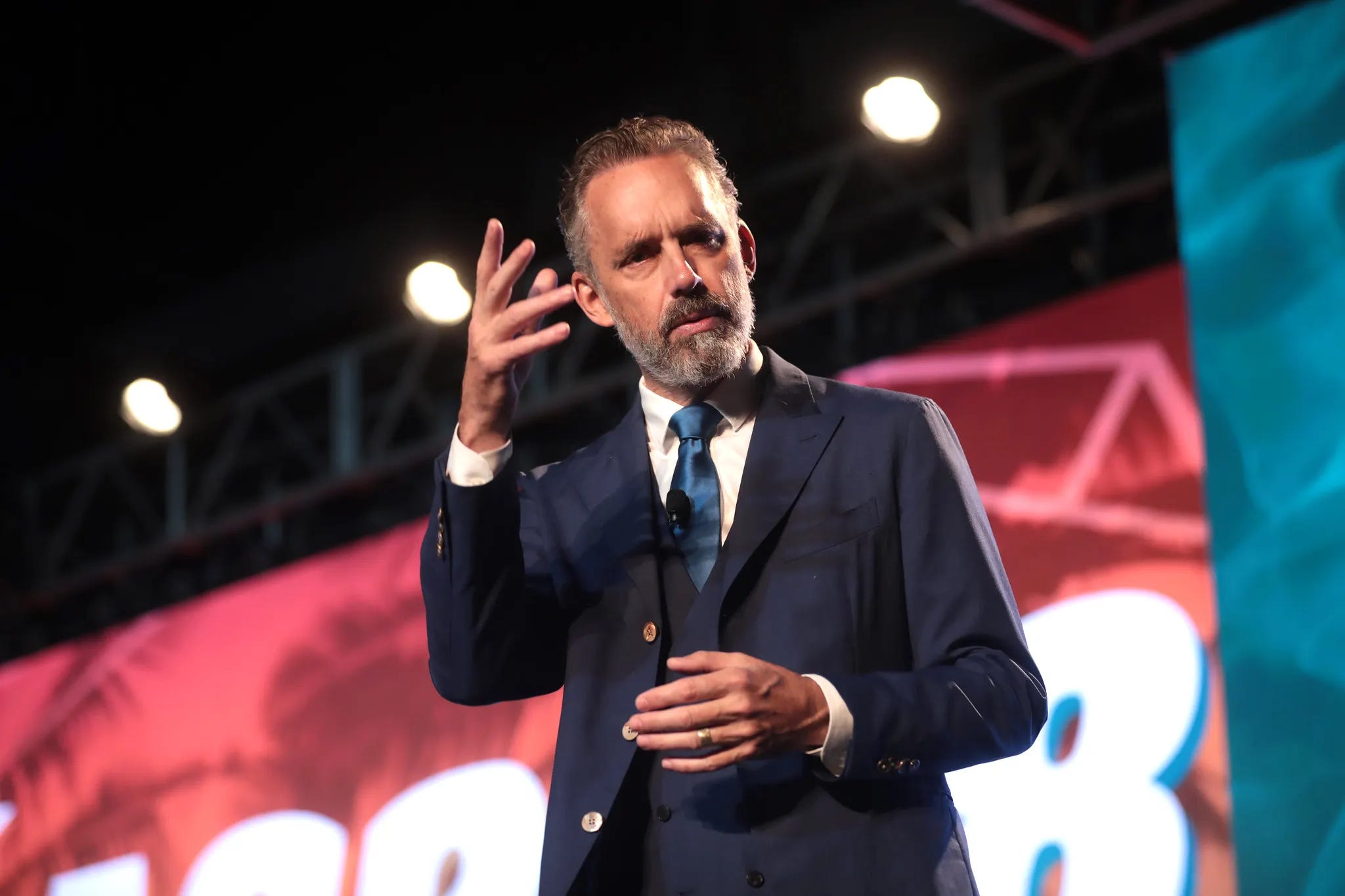
Is Jordan Peterson a theist or an atheist, or what? No one knows, least of all Jordan Peterson.
He’s been asked that question numerous times by interviewers, and in a 2019 lecture in Sydney, Australia, he admits that he’s usually given a few stock answers that dodged the question. So, he wanted to take the opportunity of that lecture to fix and expand on his answers.
In the lecture, he says (at the 1:05:35 minute mark) that the previous night he was in a televised interview, and the interviewer asked him, “Do you believe in God?” And he tells his audience, “I don’t like that question. And people have complained at me a lot, and I’m sure they have their reasons, because they don’t like my answers. I have two answers, and they’ve kind of become stock, which is not a good thing.” He later realizes he has three rather than two such answers.
The first answer he’s usually given, he says, is: “It’s none of your damned business.” This one, then, makes the question out to be “a privacy issue,” as though the question were “too private to be answered properly, and you could consider that a cop-out.”
His second answer, he says, is, “What do you mean by ‘believe’? Do you mean ‘to say the words: I believe in God’? Does that indicate that you believe in God? I don’t know what you mean by ‘believe’ exactly. And that’s got me in trouble too because people think that attempting to clarify the meaning of words is an attempt to escape from the question when it’s actually an attempt to specify the question.”
His third answer is, “I’m afraid that he might exist, which I think is the most comical of the three answers and perhaps the most accurate one.”
Only saints believe in God
He then spends around twenty minutes offering a new, more expansive answer, one that unfortunately dodges the question again in an amateurish fashion. That more considered answer of his is inspired by some lines from the New Testament, and he presents it in a nutshell form in response to the second line. I’ll quote this highly revealing answer at length, and you should note the numerous dashes that indicate that Peterson is wrestling with himself, interrupting his line of thought at numerous points. (This summary is found at 1:15:30 in the video, with my emphases.)
The other line is “Not all those who say ‘Lord, Lord” will enter the Kingdom of Heaven,” which means something approximating, “Just because you make a claim to moral virtue — let’s say your belief in God” — which I can’t see how you can make a higher claim to moral virtue than that. I mean agnostic, atheistic [at this point, Peterson’s waving his hands furiously as if to dismiss these labels] — I don’t really care. The purpose, the point is something like this: imagine something of ultimate transcendent value — I don’t care whether you believe in it or not — but imagine that something like that exists, and then you swear allegiance to it, which is to say, “I believe in this.” I mean, there’s a heavy moral burden that comes along with that, just to allow yourself to utter the words without feeling that you should be immediately struck down appropriately by lightning. And so, I think that’s why that question [i.e. “Do you believe in God?”] makes me uncomfortable.
There’s a lot to say here, but first I’ll attempt to clarify what he takes himself to be saying. Instead of answering the question directly or understanding what the question’s really asking, Peterson’s now saying in that lecture that only a saint would have the right to answer the question in the affirmative. If you “believe in God,” you should be living your life perfectly. You’d have to apply that religious belief in all your actions, demonstrating that you’ve surrendered yourself to this transcendent ideal that God represents.
As Peterson points out, even Jesus demurred when he said you shouldn’t call him good since only God is good (Mark 10:18). And of course, Peterson wants everyone — including himself — to think he’s sufficiently humble and flawed to deny that he’s personally good enough to be entitled to address the question of whether he “believes in God.”
“Believing in” versus “believing that”
Yet I still recall the undergraduate philosophy of religion course that set me straight on the difference between believing in something and believing that something is true or false. To believe in something is to trust it; as Peterson says, it’s to “swear allegiance” to it. Peterson is careful throughout the lecture to address only the question of whether he “believes in God.”
And indeed, in unsophisticated discussions of religion, that’s a question that’s bandied about. Asking that question, though, is like using the “pro-life” label when speaking about abortion, or it’s like accepting the Republicans’ label for their post-9/11 legislation, “The Patriot Act.” These labels are, of course, wholly propagandistic, meaning that they beg the questions at issue.
Obviously, if the question is only whether you trust in God or rely on God’s character the way you might trust in your friend or your government, you’ve disavowed the possibility of atheism. God would exist by way of presumption, and the question would be about your attitude towards that transcendent reality. You assume your friend exists, but you also believe in your friend, which is to say only that you rely on that person.
Somehow, then, the theistic figure of speech about “believing in God” got smuggled into the philosophical debate between atheists and theists. Addressing that question as worded would amount to chasing down a red herring, which is all Peterson does in his lecture. To be clear, the sophisticated, philosophical answer to “Do you believe in God?” is to note that the question presupposes the truth of theism, since you can’t trust in something you don’t think exists.
At that point, if the interlocutor wants a deeper answer, she might switch to the more neutral question, “Do you believe that God exists?” In other words, she might ask, “Do you believe that a person created the universe and intervenes miraculously in nature to achieve a moral plan?”
Peterson’s fourth dodge: reducing “belief that” to “belief in”
The distinction between “believing in something” and “believing that something is so” allows us to pick up on what Peterson dismisses in that part of his answer, which I quoted. He said, “I mean agnostic, atheistic — I don’t really care. The purpose, the point is something like this: imagine something of ultimate transcendent value — I don’t care whether you believe in it or not — but imagine that something like that exists.”
And again, it’s revealing how Peterson waves his hands furiously just when he finally refers to the possibility of atheism or agnosticism (at the 1:15:55 minute mark). What he’s doing there is dodging the question of whether he believes that there’s a God. The answer to that question is quite independent of the moral and behavioural questions that preoccupy Peterson in his lecture.
You can believe that God exists, but define his character in such a way as to rationalize your behaviour so you wouldn’t fear his judgment. This is what both liberal and conservative Christians do, for example. Some Christians say everyone will go to Heaven eventually anyway, while others say God wants us to prosper in earthly, not just spiritual terms. Thus, religion can be modernized with a host of moral compromises.
Alternatively, you can say that you believe there’s a God, that you’re a theist rather than an atheist, but your behaviour can indicate that you’re a hypocrite, that you don’t really believe any such thing. That was Jesus’s point about many of the Jews of his day, according to the New Testament. Like the other prophets, Jesus was calling his fellow Jews to a higher sense of purpose. He implied that if you were a theist, you ought to love God, and thus all your thoughts ought to have a pure intention. Far from just following the letter of the law, you’d think only godly thoughts. And falling short of that ideal would make you a phony, that is, an atheist who’s only pretending to be a theist.
Although Peterson addresses that Christian question of the link between our beliefs and actions, he fails utterly to understand or acknowledge that the cognitive or ontological question — of whether there really is a personal deity — is not reducible to the moral question of whether we’re living up to our ideals. God either exists or he doesn’t, or he’s either real or a figment, regardless of how we act or whether we’re saintly or hypocritical. You’re either an atheist, a theist, or perhaps an agnostic with respect to the question of whether a relatively well-defined deity is real rather than just imaginary.
Peterson’s fifth dodge: agnosticism
Indeed, towards the end of his lecture, Peterson reveals unintentionally that he’s an agnostic, which makes for yet another dodge. This is a dodge within a dodge that’s supposed to improve on his prior trio of dodges. That’s a lot of evasion from Peterson.
Here’s the telling passage (from the 1:23:45 mark, with my emphasis):
It’s not that uncommon that what we’ll do is choose to be pushed to the limit, especially when we’re at our best. We think “Where’s the limit?” It’s here. Maybe I can manage that. I’m going to push myself right to the damned limit. Then I’m going to push myself a little bit over just to see if it’s possible, and if that happens, then you emerge with a sense of triumph. I’m now more than I was, and maybe that’s what you’re here to be: to be more than you were, trying to push those limits. And to do that, you contend with the world. You wrestle with God. You don’t casually say, “I believe,” because who knows? No one knows. No one knows, right? We’re separated from the infinite by death and ignorance. We don’t know. We contend. We wrestle, and in that, maybe we can find our destiny; at least we find our purpose. We find something that justifies us to some degree.
The highlighted part seems to be Peterson’s actual answer to the neutral question of whether he believes that God exists. Implicitly, his answer to that question is, “I don’t know because no one knows.” And that answer, too, however humble the agnostic might thereby seem, is typically yet another dodge, as I show elsewhere.
Plenty of atheists, including Richard Dawkins, admit that the existence of God is possible. They just conclude that the possibility is negligible. As with the epistemic status of all empirical questions, it’s a matter of probability. A lot of what we take ourselves to know is only probable, not necessary, which means there’s a possibility we’re mistaken.
Now, I think scientistic atheists err in treating the question of theism as being purely empirical. Martin Heidegger was right to distinguish the question of beings from that of Being. Whether God exists is a philosophical question, not a scientific one, which is to say it’s metaphysical and perhaps ultimately aesthetic. Scientists can uncover evidence for or against the hypothesis, but none of that evidence will be decisive because “God” would refer to something that could be endlessly reinterpreted. God would be a supernatural, miraculously and infinitely mysterious entity, not anything you could confirm or disconfirm just by checking with your five senses or conducting an experiment.
I think Peterson would agree that the question of God’s existence isn’t empirical or scientific in any straightforward sense. We don’t know, he says, because “we’re separated from the infinite by death and ignorance.” But what that means is that we don’t know for certain. Again, we might be certain about little in life, but that doesn’t mean we should pretend we’re in the dark about most matters. We can assess the evidence at hand and make a judgment call. We can weigh the probabilities of different scenarios. If we refuse to do so, perhaps because we don’t want to alienate certain people in our lives, we’re dodging the question by calling ourselves “agnostic.”
Peterson wants to emphasize that we can only “wrestle with God,” but that, too, begs the question. It’s like confusing “belief/trust in God” with “belief that God is real.” If Peterson takes himself to be wrestling with God, he’s treating himself as a theist, which means he’d answer, “Yes, I believe that God exists.”
What Peterson should say is that we wrestle not with God himself, but with the philosophical question of whether God is real. And that would be Soren Kierkegaard’s point: both atheists and theists should wrestle with that question. Is God real? Are atheists dooming themselves to eternal agony because of their pride? Are religious people wasting their time and making fools of themselves because of their gullibility?
We should wrestle with that question, but that’s not to say we should evade it.
The only answer to "Do you believe in God?" should be "Which god? Please describe your god." If the questioner responds with "The god of the Bible." Then we are off to the races. There are 45,000+ denominations of Christianity worldwide. Do they all agree on the nature of "God"? If they all agree, why do they have so many different denominations, statements of faith, etc.? If they describe one of the specific gods of the 45000+ denominations, I might ask "How many other people worship this god?" As I said, we would be off to the races.
I was fascinated by Jordan Petersen when I first encountered him (on the internet) as he was saying things others did not. And every since my disappointment has grown.