
The Existential Choice between Modernity and Religion
Progress, submission, and the deeper debate about God

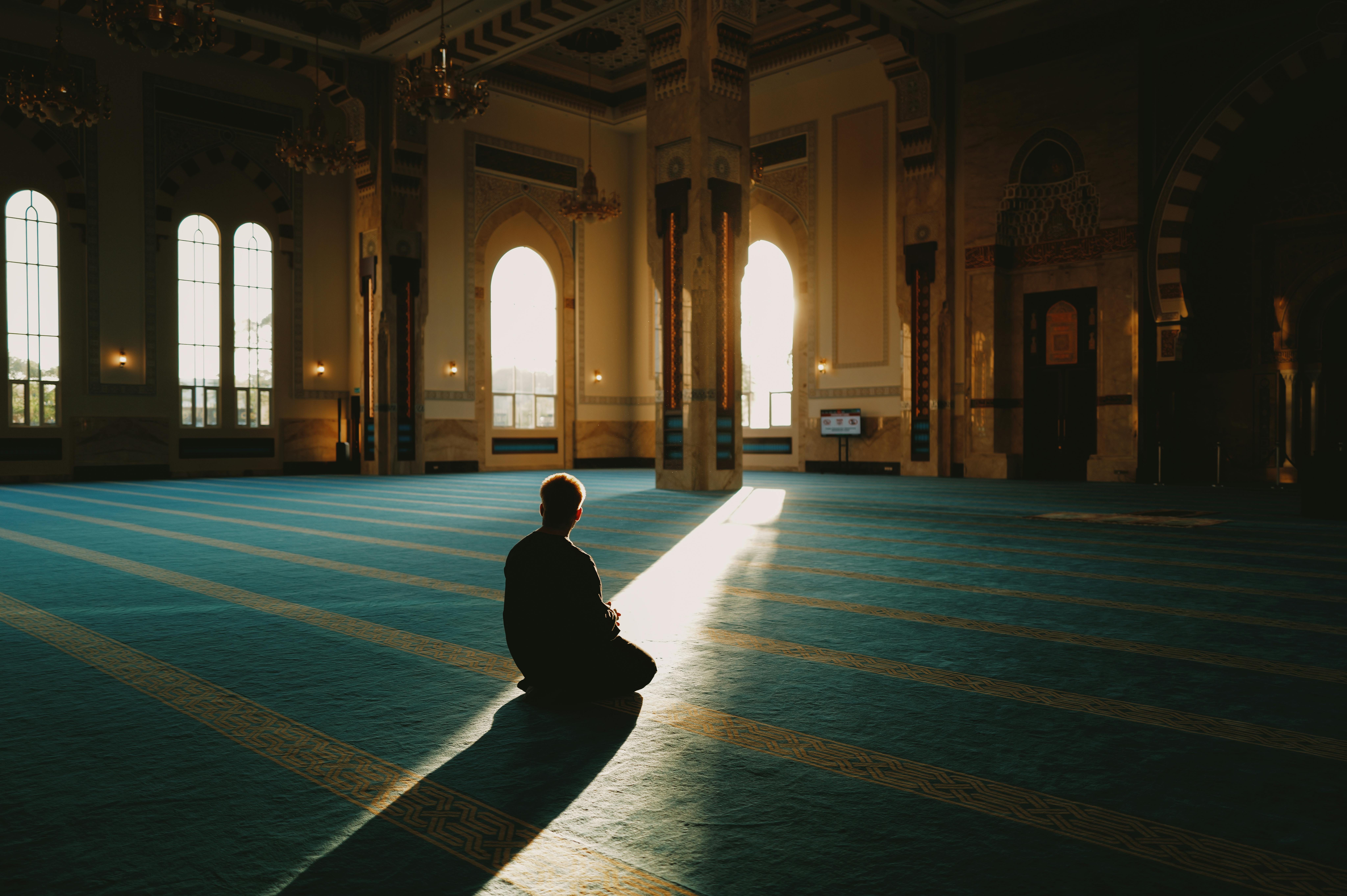
Beyond the stale, lopsided debate between believers and nonbelievers in God, there’s a hidden battleground on which both sides stumble.
You know that familiar debate about the existence of God, right? It’s the one in which secular humanists, skeptics, and new atheists piggyback on the power of science and technology to demonstrate that religion is completely irrational, dangerous, and obsolete, while mainstream monotheists, with their creeds, scriptures, and talking points, muster arguments to prove that the opposite is the case.
There are the classic theistic arguments, such as those from causality, design, ontology, and morality, and there are the philosophical refutations of those arguments. There are hundreds of formal debates along these lines that you can watch on YouTube, in which the standard pros and cons are trotted out, and the debaters duly talk past each other as if they’re following a script that’s meant not to enlighten but to amuse, reassure, or distract the audience. Hardly ever do such debates change anyone’s mind.
To be sure, the arguments for theism fail, and religion isn’t rational. Technically, in this superficial debate, the cons win, and the pros lose. But even when this result emerges sometimes from the heated back and forth, when the theist happens to be a weak performer, religion itself is unaffected. This isn’t just because secular society protects the freedom of thought and thus the right to worship.
No, religion is unaffected because the atheist’s ideal of rationality is a sham. Although you can learn much from its history of arguments about God, the entire philosophy of religion is a sideshow. Reason, meaning a combination of logic and the acquisition of evidence, succeeds in laying bare the irrationality of theism, but reason is insufficient for the rejection or acceptance of religion.
Secular progress as the modern project
As I said, the modern (as opposed to the older) philosophy of religion is a product of the Scientific Revolution and so-called “modernity” in the cultural, normative sense. That is, the recent philosophy derives from humanism, liberalism, and the capitalist trust in secular progress. Philosophy and science helped create this modernity. For example, Isaac Newton explained gravity in a way that unified the heavens and the earth, wiping out anthropocentrism with rigorous, testable equations that engineers would one day exploit to build satellites and rocket ships.
What “killed God,” as Nietzsche said, or what defeated theocracy in the West, depriving religion of its right to dominate in public, wasn’t the logic of any argument or the empirical support for any theory. Instead, it was the power afforded by clever applications of knowledge that produced new classes of dominators, such as the captain of industry, the banker, and the politician.
The modern way of life may be science-centered in that our technology depends on intellectual advances that depart from the religionist’s intuitive, parochial view of the world. But what matters is the relevance of the arguments and the evidence to what became the project of modernity. We can call that project one of humanistic progress, meaning economic growth and the elevation of living standards based on the conquest of nature.
Here’s what happened: First, modernity made theocracy obsolete by empowering new social classes that ushered in Faustian, secular culture to encourage new modes of production that made the power of ancient civilizations look like child’s play. Transport one manned M1 Abrams tank back in time to the ancient world, and that lone tank could practically conquer the Roman Empire.
Second, because of the shift in zeitgeist, theists have had to debate on the modern secularist’s terms, and maintain that religious belief is rationally justified and that religion is safe and indispensable. Premodern religion had to compete with the new consumer culture that the modern project created, so of course, those religions failed relative to those cultural standards.
Organized religion arose with the birth of civilization thousands of years ago. Before that, the magical thinking of animism and shamanism held sway for some tens of thousands of years, stretching back into the late Stone Age. We should expect, then, that the culture that suits “modernity” or the project of humanistic progress would differ as much from the cultures of ancient, low-tech, theocratic civilizations as the latter came to differ from the lifestyle of hunter-gatherers.
Implicitly, the secularist lures the theist onto the debate stage, based on the premise that secularism has already obviously triumphed. The refutation of the theist’s proofs is only a detail. Theists have lost their power to openly create a theocracy in the Western world or the Global North. Debating the theist’s pseudo-rational arguments for practicing her religion, despite that world-historic political defeat is like a wealthy capitalist kicking a beggar when he’s down, and the beggar mumbling theorems of neoclassical economics to excuse the abuse.
The skewed debate about religion in the West
To uncover the full absurdity of these debates, we need only ask whether secular progress itself is rational. Does any logic or evidence compel us to attempt to progress as a humanistic society, to increase our collective power and happiness by taming the wilderness and building an intelligently designed environment that we control?
The answer is that the modern project is rational only in the trivial sense of being instrumentally so. If we want those things, then we would be prudent to think like modernists, to pay for scientific research and create a capitalist economy and a democratic government that protects the rule of law to drive innovation. Similarly, religion is instrumentally rational, since we may use religion as an efficient way of achieving certain goals, such as scaring us into being humble and moral or dividing society into cynical elites and the masses with the latter’s predilection for comforting fictions, upon which the elites prey.
But the religious and the modern humanistic goals themselves aren’t entailed by logic or science. On the contrary, the naturalistic fallacy stands squarely in the way of any such attempted demonstration.
Moreover, if we’re speaking of “rationality” in a cultural sense, presupposing the kind of reason that’s defined by modern values, then again — trivially and semantically — the modern project would be rational by fiat. These values include classic liberalism, individualism, freedom of thought, and most importantly, trust in human nature to the point of being arrogant in acting like we have the right to rule the planet.
The conventional debate about the existence of God or the utility of religion employs rational standards in a narrow sense. The question is only whether the theistic arguments or scriptures are fallacious or whether they fly in the face of scientific knowledge. But the focus on that kind of strict rationality presupposes the modernist’s secular culture and values, which hold logic and science in such esteem. That is, reason in the narrow sense is a crucial instrument for achieving the project of modernity, for generating technological applications of empirical knowledge that please and empower our species.
There’s no need for the monotheist to revere that instrument. On the contrary, for example, Ecclesiastes takes a relaxed, jaded approach to the question of wisdom: ‘wisdom is better than folly, just as light is better than darkness…but I came to realize that the same fate overtakes them both…Then I said to myself, “The fate of the fool [death] will overtake me also. What then do I gain by being wise?” I said to myself, “This too is meaningless.” ’ (2:13–15).
Moreover, “In this meaningless life of mine I have seen both of these: the righteous perishing in their righteousness, and the wicked living long in their wickedness. Do not be overrighteous, neither be overwise — why destroy yourself? Do not be overwicked, and do not be a fool — why die before your time?” (7:15–17).
Paul in the New Testament contrasts the natural wisdom of the world with spiritual wisdom, saying that the “natural man” who is caught up in “the wisdom of this age or of the rulers of this age, who are coming to nothing,” considers spiritual truth and the power of God “foolishness” (1 Cor.2:4–14).
The Quran speaks more highly of reasoning or understanding. For example, “No one can have faith without the permission of God. God will cast down filth on those who have no understanding” (10:100). But Muslims are notorious for using reason not to embark on the humanist’s project of achieving secular progress, but to “prove” our need to submit to a higher power, thus priming Muslim populations for theocracy (camouflaged dominance hierarchy).
A fine example from the Quran: ‘They declare: “None shall enter Paradise but Jews and Christians.” Such are their wishful fancies. Say: “Let us have your proof, if what you say be true,” ’ which is an invitation to reason together. But the passage goes on immediately to say, “Indeed, those that submit to God and do good works shall be recompensed by their Lord’ (2:111). So reason, sure, but above all, submit.
Indeed, the clash between monotheistic and secular humanistic values is clearest in the case of Islam, since Jews and Christians folded under the pressure to modernize, whereas most Muslim countries have yet to reconcile themselves with cultural modernity.
So while on the surface a Muslim or a Christian may show up to a formal debate with pseudo-philosophical arguments in support of monotheism, the underlying truth is that the Muslim represents the greater threat to the secularist, not because his or her arguments are particularly sound — again, the arguments are mere details — but because even today’s Islam is a premodern phenomenon.
By contrast, the Christian stands to the secular humanist as an employee stands to her employer. The secularist can only condescend to examine the Christian’s proofs, since the war between reason and religious faith was settled in the West centuries ago, by the Renaissance, the Enlightenment, and the Scientific, Protestant, Industrial, American, and French Revolutions.
The war was won with a transfer of power from Christendom’s theocrats to capitalists, democrats, and free-thinking people, not with any mere argument or theory, since the latter is necessarily ambiguous in view of the poetic nature of scriptures and the emotional power of religious faith.
The conflict between modern and religious values
Allow me to lay out the operative divisions between these debaters. First, there’s a superficial, exoteric debate between religious and nonreligious people, which has raged on and off in the West since Presocratic philosophy. That debate is philosophical, so it presupposes the values of secular humanism. Those values triumphed with the revolutions in Europe and North America that marked the turning point between the ancient and medieval periods and “modernity.”
There’s also an underlying, secret, or unpopular debate that isn’t about whether theism or atheism is rational in the narrow sense. This hidden debate is more existential and is about whether the values of modernity are superior to the premodern values, say, of monotheism.
To pull back the curtain and enter the inner sanctum in which this more profound debate is held, we need to consider the values in question. I’ve already identified some of the modern ones, which amount to the defining features of secular humanism: individual and political freedom and power through technoscience and organized selfishness/capitalism.
The pure values of monotheism are opposed to the modern project of secular progress and are most active, as I said, in the Muslim world since the other two monotheistic faiths have largely modernized or reconciled themselves to the dominance of secular powers after the loss of their theocracies.
The essence of what we can call the monotheistic project is submission to the highest power known as “God.” In practice, this submission entails severe limits on individual freedom, ascetic renunciation of bodily pleasures, and especially the condemnation of Faustian/Satanic pride, that is, the hubris of thinking we can play God.
In a nutshell, the deepest conflict between the secularist and the monotheist lies in the fact that the former says “no” to the given world while the latter says “yes” to it.
Consistent with Eastern religions, the secularist says “no” to the natural universe, although the secularist bases that judgment on the convictions that there’s no supernature and that the free, empowered human individual can conquer nature and impose a humanized, artificial heaven or human-made paradise on the mindless, inhuman wilderness. The project of modernity is precisely the “Satanic” act of playing God, of getting to a virtual heaven by building the paradise ourselves with mastery of science and technology, and the wise channeling of our animal instincts.
The monotheist says “yes” to what she understands to be fundamental reality, to God, the supernatural, and thus nature, insofar as God designed and sustains the cosmos. She rejects, therefore, the world that departs from that reality, namely the demonic, civilized world conjured by human ingenuity or the “sin” of arrogance.
Whether the details of either of those conflicting worldviews are rational or fact-based is of little consequence because in reaching this more profound, existential conflict, we’ve left behind that scientistic standard. Feel free to regard God as a fictional character; you’ll still confront the option of living with the monotheistic mindset, an option still embraced by most of the Muslim world.
Even as an atheist who laughs at religions, you’re still able to realize that the modern project is optional and nonrational in the narrow sense, since we face an existential choice between two paths in life. We must choose between the liberal trust in our potential to improve the world and the conservative submission to nonhuman reality (the natural laws at the base of theocratic dominance hierarchies, or the figurehead of God who lords over us like Big Brother). We face the choice between accepting or rejecting the modern project in which religion is merely tolerated.
Re "Beyond the stale, lopsided debate between believers and nonbelievers ..." To people like you and me, the debate is definitely stale and a waste of time, but I think we must realize that the "debate" is much like schoolyard jokes. There are jokes that circulate in schoolyards that are limited to age groups, and the jokes get recycled as new cohorts pass through the system. Similarly, since youths aren't allowed to debate the topic of the existence of god(s) in church, they come to it as if they have just discovered such a thing were possible. And they have to work through all of the old, tired attacks and defenses. The "debate" is essentially a schoolyard for religions. And that will never end because new "debaters" enter the system year after year. It is for the same reason we send children to school to learn things we already know (reading, writing, and arithmetic), no?